
The Hollywood classic ‘Radio’ drives home a powerful message of discovery and empathy.
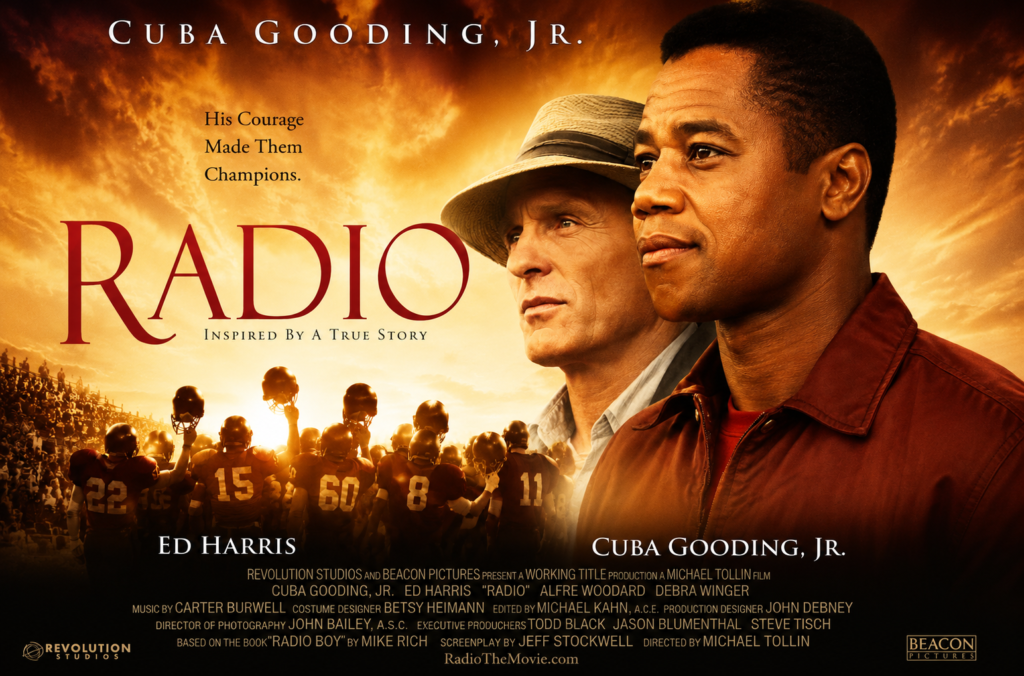
I recently watched the film Radio on Netflix, and it left me with a quiet but deeply lasting impact. Stories centered around the lives of persons with disabilities are often handled with a certain fragility—and at times, unfortunately, reduced to sentimentality. It is easy for such narratives to slip into becoming “tearjerkers,” where the individual is portrayed more as an object of sympathy than as a source of strength and meaning. I approached this film with that hesitation.
But what stayed with me were more than the expected emotional cues—it was the subtle, powerful human moments that truly defined the experience.
One moment that deeply resonated with me was when the coach, played by Ed Harris, explains to his daughter why he chose to stand up for Radio. He reflects on a missed moment from his own childhood—when he had the chance to support someone like Radio but did not act. That quiet sense of unfinished responsibility becomes his moral anchor. This time, he chooses differently. That moment, for me, was not just about compassion—it was about accountability, about recognizing that our past inaction can shape our present courage.
The real teacher
Another powerful insight comes through a simple yet profound observation made by coach’s family—that Radio, portrayed by Cuba Gooding Jr., was doing much more than merely learning from the school environment, but in fact teaching everyone around him. Teaching them how to live, how to accept, how to find joy in being different. It challenges a deeply ingrained assumption—that support flows in only one direction. In reality, individuals we often perceive as “receiving” are, in many ways, the ones giving the most—energy, authenticity, and a reminder of what it means to be human.
And then comes the moment that truly stays with you long after the film ends—the real-life Radio himself. Older now, with greying hair, still part of the same school, still in grade 11 after decades. But labels cease to matter at that point. What you see is not someone “left behind,” but someone who has, year after year, been a constant source of positivity, connection, and life within that community. His presence is not defined by progression in grades, but by the immeasurable impact he has had on generations of students.
Why Radio resonates with Akshadhaa
What made this reflection even more personal for me is the life I am fortunate to live, every day at Akshadhaa Foundation. My workplace is within the Akshadhaa premises, and I consider it a privilege to be amidst individuals with special needs on a daily basis.
Over the last decade and a half —members of society, corporate teams, students—step into this space through volunteering and inclusion initiatives at Akshadhaa. Almost invariably, they walk away with something far deeper than what they came to “offer.” There is a sense of joy, grounding, and well-being that emerges simply from being present, from engaging without filters, and from experiencing a form of human connection that is refreshingly authentic.
For me, this film turned out to be more than just about disability—it was about perspective. It gently but firmly shifts the lens from “what someone cannot do” to “what someone brings into the lives of others.” It reinforced something I have been witnessing every day—that inclusion is not an act of charity; it is an opportunity. An opportunity to experience life more fully, to unlearn our assumptions, and to rediscover joy in its simplest, most genuine form.
I truly believe that each of us should, at least once, take a conscious step towards inclusion. More as a must-do experience. Because in the company of people with special needs, one often discovers is of something, which one has always been missing within ourselves.
Go ahead and write to info@akshadhaafoundation.org