The West and East can pool complementary strengths to address multi-dimensional challenges.
Nerurodiverse individuals are increasingly being judged not only by clinical outcomes but by an individual’s ability to live independently, participate in society and sustain a meaningful quality of life.This shift is particularly relevant for autism and other developmental disabilities, where support extends well beyond diagnosis and therapy into education, employment, assisted living and lifelong community participation.
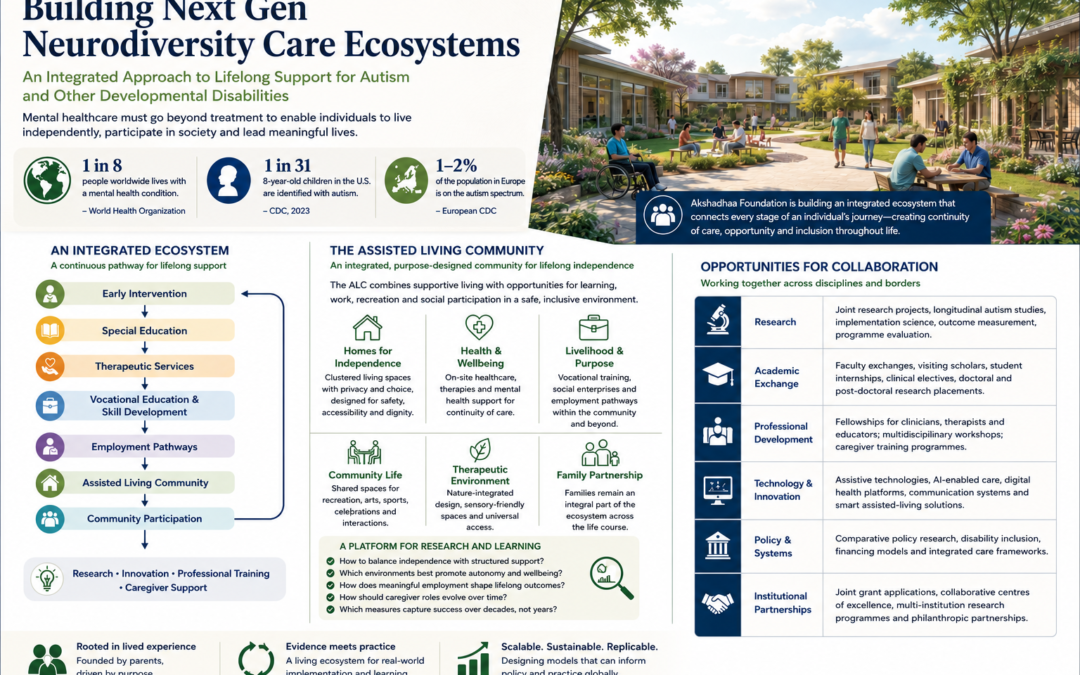
The World Health Organization estimates that one in eight people globally lives with a mental health condition. In the United States, the CDC estimates autism prevalence at 1 in 31 among eight-year-old children, while prevalence across Europe is generally estimated at between one and two per cent of the population. These trends have shifted attention from isolated interventions towards integrated models of lifelong support.
Akshadhaa Foundation has been built around precisely this principle. Established by parents with lived experience, it is creating an ecosystem that connects every stage of an individual’s journey rather than treating each phase as an independent programme.
An Integrated Ecosystem
A continuous pathway for lifelong support
→ Early Intervention
→ Special Education
→ Therapeutic Services
→ Vocational Education & Skill Development
→ Employment Pathways
→ Assisted Living Community
→ Community Participation
↺ Research • Innovation • Professional Training • Caregiver Support
Rather than asking individuals and families to navigate disconnected systems, the model seeks to provide continuity of care throughout life.
The Assisted Living Community
The Assisted Living Community (ALC) represents the Foundation’s most distinctive initiative. Conceived not as a residential facility but as an integrated community, it brings together housing, healthcare, vocational engagement, recreation and social participation within a single environment designed around the aspirations of neurodiverse adults.
Its objectives are straightforward:
- Promote lifelong independence rather than dependence.
- Enable meaningful employment and purposeful engagement.
- Support continuity of care as parents and caregivers age.
- Foster inclusion through active community participation.
- Develop sustainable and replicable models of assisted living.
The model naturally lends itself to collaborative inquiry.
1) How should assisted living communities balance independence with structured support?
2) Which physical environments best enable autonomy while remaining safe and inclusive?
3) How can employment become an integral component of lifelong wellbeing rather than a separate programme?
4) What models best support families as caregiving transitions across different stages of life?
5) Which indicators most accurately measure success twenty or thirty years after intervention?
Because these questions arise within an operational community, they can be examined through longitudinal observation, multidisciplinary research and evidence-based evaluation, generating insights that extend beyond conventional clinical settings.
Opportunities for Collaboration
| Domain | Illustrative Opportunities |
|---|---|
| Research | Longitudinal autism studies, implementation science, outcome measurement, multidisciplinary research, programme evaluation |
| Academic Exchange | Faculty exchanges, visiting scholars, student internships, doctoral and post-doctoral research, clinical electives |
| Professional Development | Fellowships for clinicians, therapists and educators; multidisciplinary workshops; caregiver training programmes |
| Technology & Innovation | Assistive technologies, AI-enabled care, digital health platforms, communication systems and smart assisted-living solutions |
| Policy & Systems | Disability policy research, integrated care frameworks, financing models and ecosystem evaluation |
| Institutional Partnerships | Joint grant applications, collaborative centres of excellence, multi-institution research programmes, philanthropic partnerships |
These collaborations are intended to be reciprocal. International institutions contribute scientific expertise, specialised clinical knowledge and established research networks. Akshadhaa offers a functioning ecosystem where integrated models of care can be implemented, observed and refined in everyday practice, generating evidence that informs policy, strengthens professional practice and improves long-term outcomes.
Akshadhaa Foundation invites universities, hospitals, research institutions and philanthropic organisations to partner in this endeavour through collaborative research, fellowships, internships, academic exchanges and technology partnerships that advance integrated models of lifelong care.
Reach out to us anirban@akshadhaafoundation.org